




From Field to Port: How We Built Commodity Intelligence From Five Government APIs
Commodity traders spend thousands per month for data that governments publish for free. We just wired five of them into a live intelligence layer.
The Problem With Vessel-Only AIS Intelligence
Most maritime intelligence platforms tell you where a vessel is. Fewer tell you what it's carrying. Almost none tell you what it's likely to carry next week.
AIS data alone captures the final act — the vessel arriving at port. By that point, the loading decision was made 2–4 weeks earlier, when grain trucks left Mato Grosso, when soybeans cleared Mississippi River locks, when Brazilian harvest forecasts revised upward. If you're trading Brazilian grain futures or managing a shipping portfolio, the vessel arrival is confirmation of information you should have had a month ago.
We built a pipeline to capture those earlier signals.
Five Sources, One Intelligence Layer
The commodity intelligence layer ingests five government datasets that each capture a different point in the supply chain from field to port:
USACE Mississippi River Barge Data — The US Army Corps of Engineers publishes weekly barge tonnage through key Mississippi River locks. Corn: 8.6M tons, soybeans: 4.8M tons, wheat: 1.7M tons tracked in the last reporting window. Downbound grain tonnage at Locks 25–27 is a validated 2–3 week leading indicator for US Gulf grain exports. When that flow spikes, Gulf bulk carriers load 2–3 weeks later.
CONAB Brazilian Crop Supply Surveys — Brazil's national supply company (CONAB) publishes monthly harvest progress and production forecasts by state and commodity. We ingest the latest survey per crop year: Brazil soybeans 2025/26 at 177.8 million tonnes (+3.7% YoY), corn at 2.49M tonnes (−8.9%). These forecasts move Santos and Paranaguá loading schedules weeks before vessel bookings are confirmed.
ANTT Road Freight Counts — Brazil's national land transport agency publishes monthly road freight data via CIOT (cargo tracking operations). Mato Grosso soybeans: 975 truck trips. Bahia: 1,718. Goiás corn: 336. Each truck trip to a grain port is a precursor to vessel loading 1–3 weeks later. We convert trip counts to estimated tonnes (1 trip ≈ 27 MT) and compute weekly z-scores to flag unusual spikes.
ANTAQ Vessel Calls (with Cargo Manifest) — Brazil's waterway transport authority publishes full vessel arrival/departure records for major grain ports, including cargo tonnage from a separate manifest file. We now cross-reference these against our hydrostatic cargo estimates — when the declared manifest diverges from what the draft change implies, that's a signal worth investigating.
CEPEA World Bank Commodity Prices — Daily physical commodity prices for soybeans, corn, sugar, coffee, and cotton from the World Bank Pink Sheet. 39 months of history. The current soybean z-score: +2.1 (elevated, rising trend). Coffee just printed +4.0% MoM. We generate axiom_events automatically when any commodity crosses ±1.5 sigma or ±10% month-over-month.
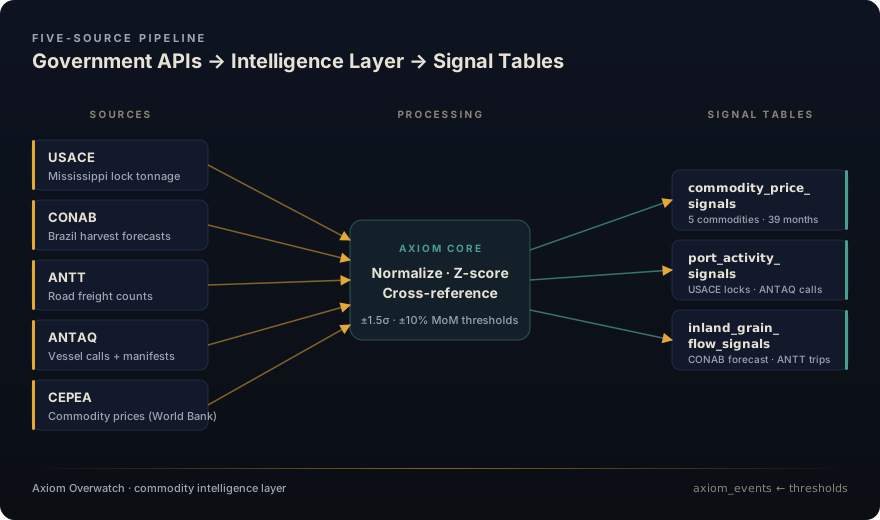
Five government APIs feed a single intelligence layer that emits three signal tables — and triggers axiom_events when any series crosses the thresholds.
What the Signals Look Like
The intelligence layer computes four signal tables refreshed automatically:
- commodity_price_signals — 195 records across 5 commodities, 39 months, with MoM change, YoY change, 12-month z-score, and trend direction
- port_activity_signals — weekly vessel call frequency and average dwell time at 5 Brazilian grain ports, with 8-week z-scores
- inland_grain_flow_signals — weekly barge tonnage (USACE Mississippi) + estimated truck flow (ANTT Brazil) by commodity, with surge/decline classification
- production_forecast_signals — national production by commodity/crop_year (latest CONAB survey), with YoY revision
All threshold crossings automatically generate axiom_events: trade.commodity_price_spike, trade.commodity_price_crash, trade.crop_forecast_upgrade, trade.crop_forecast_downgrade. These flow into the same temporal event graph as vessel dark events, spoofing detections, and sanctions flags — creating cross-domain correlation opportunities that no single-domain platform can offer.
Lead Times and Trading Value
Each source captures a different point in the supply chain, with different lead times to vessel loading:
CONAB harvest forecasts update monthly and lead vessel loading by 4–8 weeks. ANTT truck counts lead by 1–3 weeks. USACE lock passages lead by 2–3 weeks. ANTAQ cargo manifests confirm what was actually loaded. CEPEA prices are concurrent but reflect demand conditions that determine whether loadings happen at all.
Used together, they form a 4–8 week forward visibility window into grain port activity at Santos, Paranaguá, Itaqui, Rio Grande, and Vila do Conde — Brazil's five major grain export terminals and the origin of roughly 40% of global soybean trade.
The current signal stack shows Brazilian soybean prices 2.1 standard deviations above their 12-month baseline. The 2025/26 crop is tracking 3.7% above last year. Mato Grosso truck flows are active. By the time bulk carriers are confirmed loading at Santos, commodity traders with access to this signal chain already knew it was coming.
What's Next
The next additions to the commodity intelligence layer:
- GFW SAR vessel detection (O-11 in the roadmap) — cross-referencing satellite radar detections against dark events at grain port anchorages
- ANTAQ cargo tonnage enrichment — the Carga.zip integration is live; first full cargo-enriched dataset lands next Monday's cron run
- CONAB harvest progress — the production forecast is live; harvest progress percentage requires a separate Conab endpoint we're adding next
- USACE lock expansion — currently Mississippi River; adding Ohio and Illinois River lock data for Midwest corn flows
The commodity intelligence layer is live and automatically refreshing. Every Monday the ANTAQ and USACE crons run. Every 12th and 16th, CONAB and ANTT update. Every day at 20:00 UTC, CEPEA prices land.
The field-to-port signal chain is open.
Axiom Overwatch tracks maritime commodity flows, vessel behavior, and trade intelligence. View the platform →